
Exposed but Unaware: Beyond Smokey Mountain’s Transformation
For many Filipinos, the name Smokey Mountain immediately evokes images of towering piles of garbage, smoke-filled skies, and families struggling to survive in one of the country’s most recognizable dumpsites. Located in Tondo, Manila, Smokey Mountain became one of the largest open dumpsites in the Philippines and, for decades, served as both Metro Manila’s disposal site and the workplace of thousands of informal waste workers. Abad (1991) described Smokey Mountain as a place where scavenging was not merely an occupation but a way of life for families who had few opportunities outside the informal waste economy.
The conditions that shaped the community reflected more than the country’s waste management challenges; they exposed the realities of urban poverty. The International Labour Office (1995) documented that waste pickers, including children, were regularly exposed to hazardous waste, polluted surroundings, and unsafe working conditions while earning a living from discarded materials. Yet despite these dangers, waste picking remained one of the few accessible sources of income for many residents, making occupational risks an accepted part of everyday life.
A significant turning point came with the closure of the dumpsite in the 1990s. Through the Smokey Mountain Development and Reclamation Project, the government sought to rehabilitate the area by replacing the former dumpsite with housing developments and other urban infrastructure, an effort discussed in Chavez v. National Housing Authority (2007). Although the mountain of garbage eventually disappeared, the community itself remained, adapting to new realities while preserving the social ties that had been built over generations.
Today, Smokey Mountain is often remembered for what it once was. Yet behind that familiar image lies a community whose story did not end with the closure of the dumpsite. Instead, it continues to evolve through the resilience of the people who have remained despite decades of social and economic change.
This article argues that although Smokey Mountain has undergone a remarkable physical transformation, the experiences of many residents remain largely unseen. Looking beyond the community’s redevelopment reveals not only a story of resilience and adaptation, but also of the people whose lives continue to be shaped by its history.
From Dumpsite to Community
For decades, Smokey Mountain stood as a symbol of both waste and survival. According to Abad (1991), thousands of families settled around the dumpsite because scavenging provided a means of earning a living despite the difficult and hazardous conditions. What began as a disposal site gradually developed into a community where generations of residents built homes, raised families, and formed livelihoods around the informal waste economy.
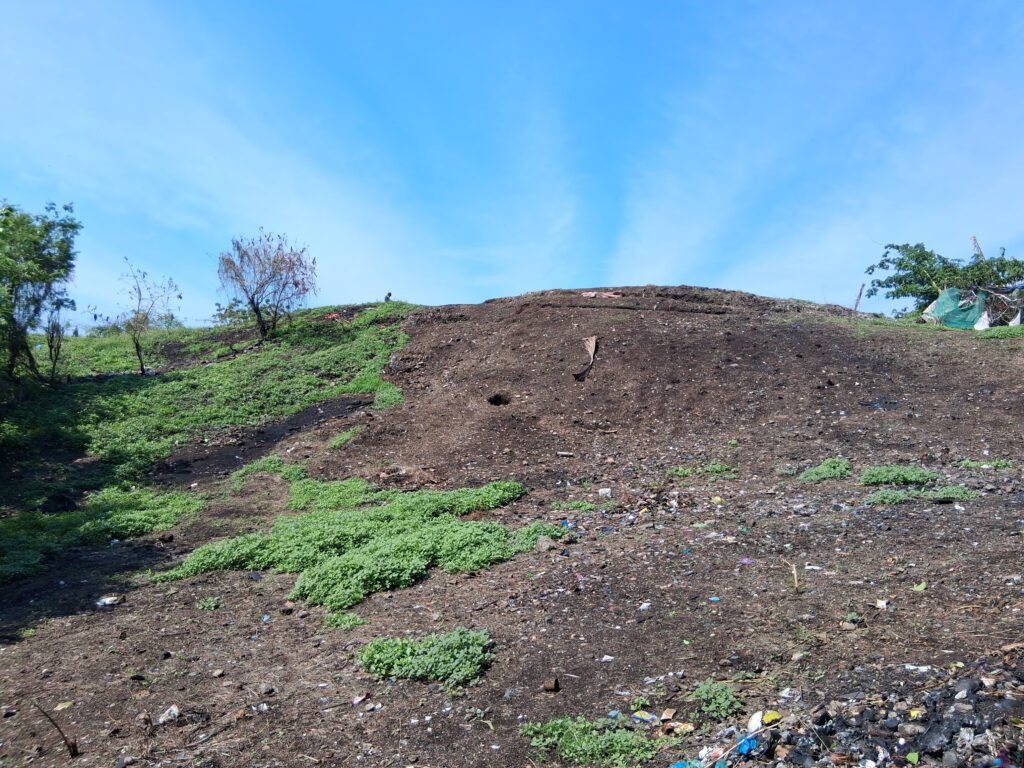
The closure of the dumpsite marked the beginning of a new chapter for Smokey Mountain. Government redevelopment initiatives transformed portions of the former dumpsite into residential communities and other public spaces as part of broader rehabilitation efforts (Chavez v. National Housing Authority, 2007). While the mountain of garbage disappeared, the people who had long called Smokey Mountain home remained, adapting to new circumstances while preserving the sense of community that had sustained them for generations.
The transformation of Smokey Mountain demonstrates that redevelopment is not measured solely by changes in infrastructure. It is equally reflected in the community’s ability to adapt, preserve its identity, and create new opportunities despite decades of economic hardship. One of the most visible transformations in Upper Smokey Mountain today is the emergence of urban farming. Residents shared that vacant spaces once associated with waste have gradually been converted into small gardens where vegetables such as talbos, saluyot, alugbati, talong, and malunggay are cultivated. These crops provide food for households while also generating modest income through sales in nearby markets.
Urban farming reflects more than a change in livelihood, it symbolizes the community’s determination to reclaim a place once defined by waste. Where mountains of garbage once stood, patches of green now thrive through the collective efforts of residents. Even with limited resources, they have transformed available land into productive spaces that contribute to both food security and household income.
The story of Smokey Mountain did not end when the garbage disappeared. While the landscape has changed, many residents continue to build their lives around informal work and the opportunities available to them. Behind every garden, every rebuilt home, and every livelihood is a community that continues to navigate the challenges of survival, stories that are often overlooked despite the remarkable transformation of the place they call home.
Livelihood Beyond the Dumpsite
“Tondo, Manila? Then it must be known for Smokey Mountain” as many others would say.Because of the community’s recycling facility and of the open dumpsite that used to operate in the same area, many individuals share the same livelihood and have been surviving due to this — waste picking. For most people in Tondo, waste picking has been a major source of income. In a country where high work standards are upheld yet wages are not enough for daily survival, many are forced to make a living out of anything. People living in poverty often resort to waste picking because it is the variably available job to take — one that does not require high educational attainment and other sorts of documents that are hard to acquire. Although it might need physical hard work, and probably a well-functioning immune system to endure all the possible hazards there are in the workplace. According to Wu and Zhang (2019, as cited in Sicam, 2023), waste pickers often engage in waste collection not only out of necessity but also for the autonomy it provides. To which I can closely associate with the very condition of the informal waste workers in Tondo, Manila who capitalizes on sariling diskarte and kasanayan to provide for their families because indeed, may pera sa basura.
One interviewee has been picking and collecting waste day to night for 30 years, with the help of the sidecar that a neighboring junk shop freely lent him. He has been through various routes searching for junks that he could still sell and earn from — Quezon City, Sampaloc, and even in Tondo just to make a living even in the dawn, while paddling his sidecar despite everything. The next morning, he would go to the neighboring junk shop to sort all the plastics, cartons, papers, and electronic wastes he had collected and sell them to buy food for his family, then do the same work thereafter.
“Sapat minsan, madalas hindi,” and yet despite these uncertainties and lackings, they go through different dangers as they paddle through from city to city — and face threats even in their own community brought about by demolition for so-called development — just to make ends meet. Even the mountains of garbage are no exemption to gunfires. People who have lived their lives in the mountains suffer from intimidation and sabotage — being deprived of water and electricity — forcing people to voluntarily leave their homes so the private companies can finally develop. Waste pickers from the area are banned from bringing their kalakal in the community, forcing them to leave it foothill — and suddenly, “nanakaw sa baba yung kariton at kalakal niya,” became a normal phrase to hear from their families.
Exposed but Unaware: The Hidden Costs of Waste Picking
Life is tough and so are the waste pickers who give it their all and endure everything just to put food on the table. When asked about the challenges they face everyday, one thing similar among them is they all end their statements with “sanayan nalang.” A word too cruel to hear that signifies how they are forced by their situation to get used to everything — including all the risks and hazards that come with their livelihood which have become part of their everyday lives.
Informal workers are named the unsung heroes of our society because of their significant contribution in waste management despite the little to no support they get. Studies reveal that waste-related occupations are among the most precarious jobs to take due to the occupation hazards and health risks associated with improper handling of different kinds of wastes (Hermocilla, 2025; Sicam, 2023; United Nations Development Programme, 2025). Hermocilla’s (2025) study on the lived experiences of solid waste management workers revealed the 3 major hazards in waste-related work: (1) physical hazards, (2) biological hazards, and (3) psychosocial hazards which all describe the natural poor working conditions and environment in the sector.
Everyday, waste pickers face constant danger in the streets. There are endless possibilities of accidents that can happen — which, unfortunately, many have experienced. However, they also suffer from poor health coverage which forces them to self medicate when they encounter safety and health hazards due to the nature of their work. This poses a serious threat to their well-being because oftentimes, self medication does not guarantee recovery and doing so without proper training may only worsen one’s condition.
In our interview, we were told a series of accidents they encountered while at work. A co-worker of one interviewee was hit by a 16-wheeler truck along the highway while collecting wastes. Unfortunately, he did not survive and was dead on arrival. It is also not alien to us that waste pickers are often exposed to hazardous wastes that are not visible to the naked eye. They may not be aware, but they may be exposed to infectious, radioactive, and sharp wastes and toxic chemicals that are dangerous to one’s health. Another waste picker from the community mentioned exposure to ammonia from hazardous wastes of hospitals. He opened up that this is also among his concerns in his job because of its possible impact on his health, but he still continues to scavenge because he had no other choice. Most threateningly, one of the waste pickers in the community revealed that he was recently diagnosed with Tuberculosis after years of working as a scavenger, forcing him to stop from working as he takes his medication for 6 months.
The condition of the waste pickers in Tondo is clearly at the bottom, getting worse even. The hazards they face have become part of their daily living and more so their job which constantly puts them at the edge. For them, due to the difficulty of life, “sanayan nalang” is their rebuttal to whatever life throws at them. As long as they get to make a living, it is enough. As long as it means providing for their family, they tread paths lined with invisible hazards.
Conclusion
In the country’s campaign to Zero Waste, the reliance is on the waste workers, including the informal ones who are the unsung heroes of our society. However, despite their significant contribution to the waste management system of the country, they are often unrecognized. The work hazards are never addressed, but further intensified. They constantly face lack of access to social services and suffer from social marginalization and stigmatization which is detrimental to their psychosocial well being (Sicam, 2023).
Just like how the health hazards are not visible to the naked eye, our country’s waste workers are also as if invisible to the eyes of the many — even to the government who should have long recognized them for their role in waste management. People were forced to adapt to survive on their own. The importance of occupational safety and health has been overlooked — workers are placed at the pedestal, waiting for someone to save them from all the occupational hazards and livelihood threats that come their way. Although seminars and training are provided by non-governmental organizations, support and protection from the government is extremely necessary especially for the informal waste workers who are constantly exposed to different hazards.
This discussion also points to a deeper issue — of how extreme poverty and their living condition is that not even a matter of life or death scenario can hinder them from doing their job to provide for their families. In the words of a waste picker, “maraming umaasa sa basura” because the lives of the people in Tondo are testaments to this. The very stories we hear of and the situations we see serve as a wake up call for people in office to take action — to listen to create space for the waste workers, to address their poor working conditions, and to improve the living standards of all people, especially those living in poverty.
About the Authors

Ken Sevilla and Alexah Vicente are 3rd year students of the UP Manila Political Science Program. During their internship, they immersed in the communities of Smokey Mountain and parts of Tondo, Manila. Their work contributed to the occupational, environmental health and safety advocacy of IOHSAD, following the recent landfill disasters in the Philippines.
References
Abad, R. G. (1991). Squatting and scavenging in Smokey Mountain. Philippine Studies, 39(3), 263–286.
Chavez v. National Housing Authority, G.R. No. 164527 (Supreme Court of the Philippines, August 15, 2007). LawPhil. https://lawphil.net/judjuris/juri2007/aug2007/gr_164527_2007.html
Hermocilla, M. C. (2025). Lived Experiences of Solid Waste Management Workers in Cardona. Rizal: A Qualitative Inquiry into Occupational Hazards and Compensation Needs, J Clinical Case Studies and Review Reports, 2(2), 22.
International Labour Office. (1995). Helping the hard ones: Child scavengers in the Philippines. International Labour Office. https://www.ilo.org/publications/helping-hard-ones-child-scavengers-philippines
Sicam, O. (2023). The Production of Space in the Informal Waste Economy: Waste Picking in the Tondo Manila Bay Area. The Journal of Public Space, 8(1), 43-68.
United Nations Development Programme. (2025). “We work with dignity”: Meet the women waste workers from the Philippines who keep plastics out of Our Ocean | United Nations Development Programme. https://www.undp.org/philippines/stories/we-work-with-dignity