
IOHSAD Statement on World Environment Day 2026
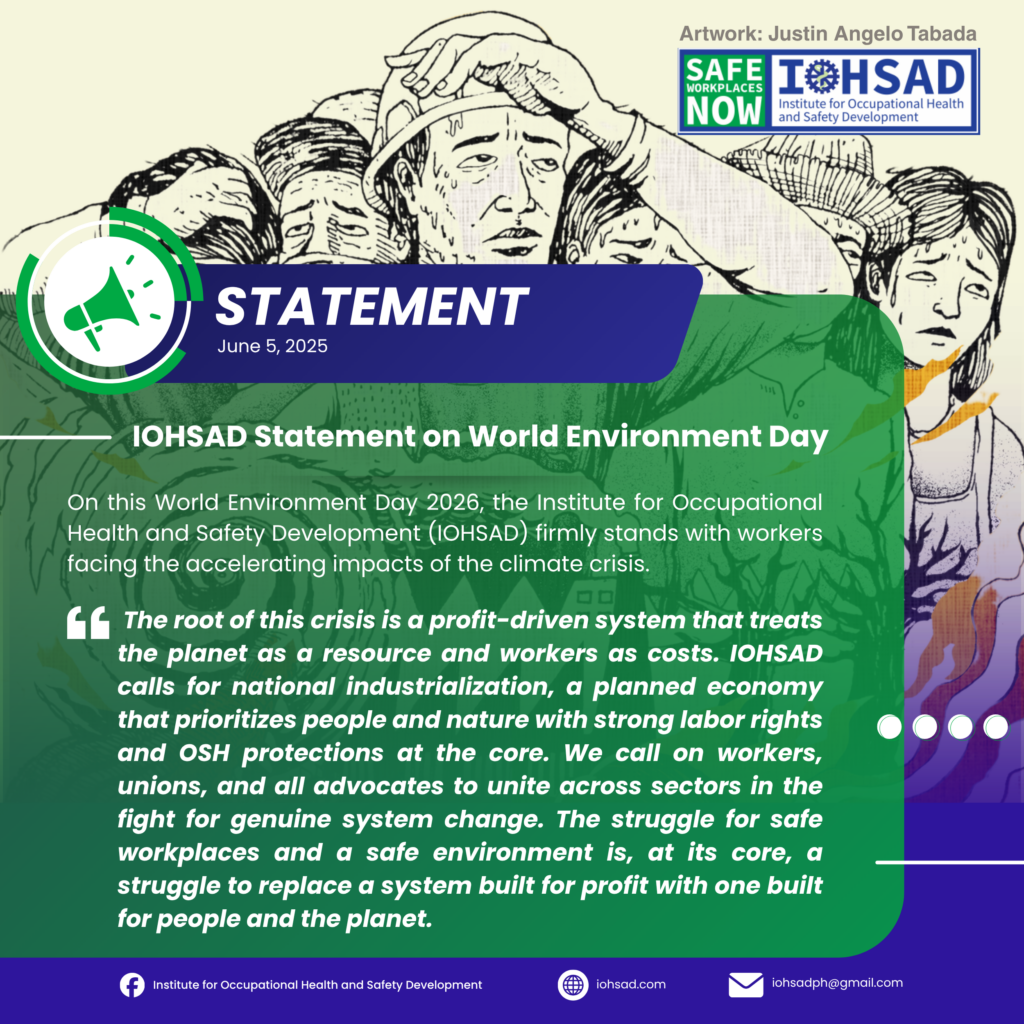
On this World Environment Day 2026, the Institute for Occupational Health and Safety Development (IOHSAD) firmly stands with workers facing the accelerating impacts of the climate crisis. The fight for environmental protection and justice is inseparable from the struggle for workers’ health, safety, and rights. IOHSAD commits to raising workers’ awareness of this inseparable connection and to assisting them in confronting violations and neglect of their fundamental occupational, environmental, and health and safety (OEHS) rights.
Climate change is actively creating and intensifying occupational health and safety hazards across all industries. Workers suffer extreme temperatures whether inside poorly ventilated factories or in agricultural lands and construction sites. Informal workers such as jeepney and delivery drivers, street vendors, endure punishing heat daily just to earn a living, with no protection and no employer accountable for their condition. Heat exhaustion, heat stroke, and death are the real and growing consequences of a warming Philippines. According to Boston Consulting Group analytics, Filipinos exposed to extreme heat indices exceeding 42°C are projected to reach 11 million by 2030 and 74 million by 2050.
Companies routinely treat workers as weather-proof. During typhoons and flooding, employers, particularly in the BPO industry, have repeatedly violated workers’ right to refuse unsafe work, compelling call center employees to report despite signal warnings and rising floodwaters. Workers have waded through waist-deep contaminated water under threat of disciplinary action or loss of pay, exposing them to injury, leptospirosis, and other waterborne diseases. This is a systemic pattern of prioritizing corporate operations over workers’ lives.
Workers in manufacturing, construction, mining, and transport are meanwhile daily exposed to chemical fumes, industrial dust, and vehicle emissions that the climate crisis is making worse, slowly and silently destroying their health. And beyond the physical, the climate crisis wears down workers’ minds. Those who survive typhoon after typhoon, come home to flooded houses, or watch their communities destroyed carry a burden of trauma and exhaustion that existing OSH frameworks almost entirely ignore.
Those who have contributed the least to the climate crisis shoulder its heaviest burdens. The responsibility lies squarely with profit-driven corporations whose relentless pursuit of profit has driven ecological destruction on a planetary scale. The Binaliw landfill tragedy, where privatized waste management claimed the lives of 39 workers, illustrates this with brutal clarity. Prime Waste Solutions, under the corporate empire of oligarch Enrique Razon, turned a public function into a profit center — and workers paid with their lives. They were not killed by a natural disaster but by a system enabled by a government that privatized essential services, weakened OSH and environmental regulations, and maintained a culture of impunity that shields corporations while workers continue to die.
IOHSAD demands that companies be mandated to integrate climate-adaptive measures into their OSH programs. Heat stress protocols, emergency preparedness plans, air quality monitoring, and psychosocial support should be standard and non-negotiable requirements. Violations and neglect of environmental and OSH standards must be criminalized. The Binaliw tragedy must not pass without justice. Those proven responsible must be held criminally accountable.
Yet climate-adaptive OSH measures, however urgently necessary, are not enough. The root of this crisis is a profit-driven system that treats the planet as a resource and workers as costs. IOHSAD calls for national industrialization, a planned economy that prioritizes people and nature with strong labor rights and OSH protections at the core. We call on workers, unions, and all advocates to unite across sectors in the fight for genuine system change. The struggle for safe workplaces and a safe environment is, at its core, a struggle to replace a system built for profit with one built for people and the planet.